AI Opportunity Assessment
Identify where AI can improve workflows, service operations, reporting, or internal decision support.

AI implementation that holds up beyond the pilot
We help companies move from AI ambition to operational reality — identifying the right use cases, implementing them in real workflows, and making sure the work holds up once teams are actually using it.
What we're built for
Built for companies that want operational improvement, not AI theater.
The gap we close
Leaders are being told to use AI, but most organizations do not need more ideas. They need a clear implementation path, the right use cases, and confidence that the work will improve how the business actually runs.
We bridge that gap — turning AI interest into structured, usable systems tied to real workflows and measurable outcomes.
Core services
Built around the work inside the business, not around generic AI talking points.
Identify where AI can improve workflows, service operations, reporting, or internal decision support.
Reduce repetitive manual work and improve consistency across internal and customer-facing processes.
Connect AI into the systems and processes your team already uses so implementation holds up in practice.
Support adoption, refine performance, and keep implementation aligned with changing business needs.
Map the process, the bottleneck, and the implementation path before building anything.
Focus on use cases that are commercially useful and operationally realistic.
Support adoption with clearer usage patterns, better fit, and staged implementation.
Operational visibility
The fastest path to useful AI is not a bigger tool stack. It is a clearer operating picture: where work enters, where time gets lost, where decisions repeat, and where implementation can create leverage.
Understand handoffs, repetition, and friction before choosing a solution.
Implementation is shaped by your team, systems, and operating constraints.
Business outcomes
Reduce repetitive handling work in intake, triage, reporting, coordination, and internal response processes.
Improve response speed, handoffs, and operational consistency without forcing teams into a full systems reset.
“AI is only useful when it changes how the business actually runs.”
Give teams faster access to the right internal context instead of leaving them to search across scattered systems.
Surface clearer inputs, summaries, and operating signals so managers can act faster and with more confidence.
Connected systems
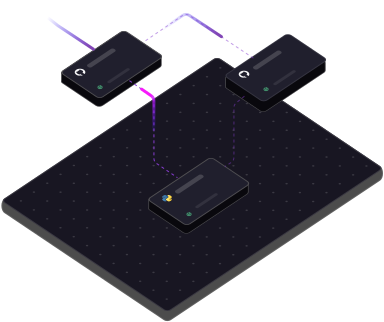
Useful AI rarely lives in one screen. It needs to connect with service workflows, internal knowledge, reporting habits, and team decisions so the business gets a better operating system, not another disconnected tool.
Explore implementation servicesProcess
Review workflows, pain points, systems, and constraints to identify where AI is worth applying.
Rank use cases by business value, feasibility, risk, and readiness.
Design and integrate solutions that support actual work, not isolated experiments.
Support adoption with guidance, documentation, training, and practical rollout support.
Track performance, refine where needed, and build toward the next stage of value.
Why work with us
Case study examples
Mapped repetitive intake and response tasks, introduced AI-assisted processing, and improved turnaround time and consistency.
Created an internal assistant for policy and process retrieval so teams could find accurate answers faster.
People and adoption
Teams adopt new ways of working when implementation is structured around what they already do — not bolted on after the fact. We treat adoption as part of delivery, not a separate problem to solve later.



Questions decision-makers ask
Start with an assessment. The right first move is usually the opportunity with the strongest combination of business value, feasibility, and operational fit.
Data handling, tool selection, access controls, and governance should be part of implementation planning from the beginning, not added later.
Usually no. Most effective implementations improve workflows around the systems you already rely on rather than forcing a full replacement.
Adoption depends on workflow fit, clarity, training, and rollout discipline. We treat enablement as part of delivery, not an afterthought.
Next step
If you are evaluating where AI can improve operations, customer workflows, or internal productivity, the best next step is a consultation scoped to your specific situation.